Thursday, January 8, 2015

CLOSING DAY NOVEMBER 2014 NYC PIER ANTIQUE SHOW


It’s early Sunday, day two of the NYC Pier Antique Show and you’re already up and at the 94th street pier parking lot off loading your 2nd round of quality hand picked pieces and with help, you carry your new inventory to your installation. This has become old hat to you. You’re a pro now. You’re relaxed. You’re confident. You re-arrange the inventory to allow for the new pieces. You clean and polish everything. Put out more business cards and brochures. You’re ready for day two and with several hours to kill before the doors open to the public; it’s time for coffee and conversation. It’s time to meet, mingle and compare notes about the successes of Saturday’s turnout.
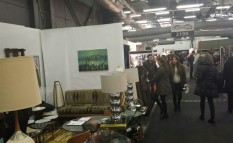
With this early morning free time you swing past nearly every relevant booth and installation in the cavernous Pier 94th street pier.
An anticipated announcement comes over the PA system reminding you that you have 30 minutes before the doors open and another message, a warning, about breaking down your installation before the show is over. Don’t do it. You could be banned from participating in other events put on by the shows promoter, U.S. Antique Shows.
This time you make a stop by the food concession and load up on breakfast bars and water for snacking during the show and one more cup of coffee for the hike back to your installation.
With the water and breakfast bars stowed under the Adrian Pearsall sofa and the coffee now downed you are ready to face the public. The doors are open and here they come.
The crowd starts out on the light side. I suppose many New Yorkers are sleeping in, going to brunch or on their way to church. However, as the temperature outside warms up so does the foot traffic on the inside. Yesterday’s window shoppers have returned and are buying today. The energy is slower today. People are more relaxed. It feels good.
The late morning ease sets the tone and the balance of the day progresses smoothly.
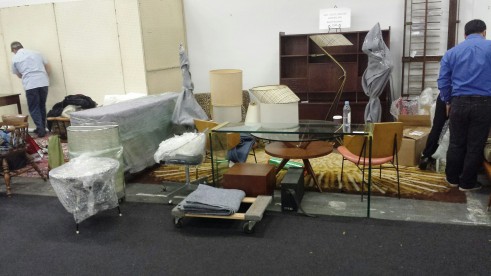
Towards closing you start thinking about breaking down your installation. Packing everything and safely loading your goods into your truck is forefront on your mind. And secondly, the 4 plus hour ride home. We are getting near the end of the event and the pier is emptying out. The high speed pace of the weekend has almost ground to a halt and is shifting into the breakdown mode. Everyone is exhausted and cranky and facing the same tasks. Blankets, boxes, shrink wrap, packing bubbles all begin to reappear and the last phase of the event is underway. Porters have returned and are racing rewrapped product back to the trucks that have been filling up the parking lot. The crew that manages the parking, security and traffic are doing an amazing job. The grand exit of over 400 venders runs smoothly. Quick goodbyes to new and old friends and we’re off into the traffic, bright lights and the tall buildings of New York City. Next stop…Boston MA
Now that I have had time to reflect on the Pier Show I have realized that the true wealth and value that I obtained came from the connections that I made and all that they shared with me. Those connections, my new friends, are priceless.
Will I be doing the NYC Antique Pier Show again? You can count on it.

OPENING DAY NYC PIER ANTIQUE SHOW 2014


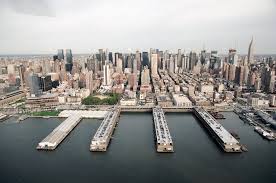
It’s 7:30 a.m. Saturday morning in NYC. There is plenty of free parking to be had this early in the morning in this part of town. It’s a short walk to the 94th street pier from here. Taxis are dropping off exhibitors at the front doors of the show. You slip through the small crowd and flash your exhibitor photo id to the security at the door. You are ushered in past more security and you quickly walk to your installation hoping that everything is still there and in place and of course it is.
Another look, you double check everything.  It can’t get any better.  You’re good.

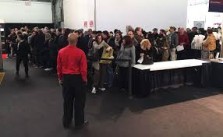
Now you can mingle as the crowd waiting outside builds. The early morning pre-show hours both Saturday and Sunday are like professional association meetings. Mixing is very important. I learned so much from other like minded professionals. We compared notes about our sales, pricing, customers, products and what was trending and what wasn’t.  The camaraderie, solidarity between all 400 plus of us was healthy and energizing. At 9:30 an announcement comes across the PA system “the doors will be opening in thirty minutes please be ready.” And with that we wrap up our conversations and head back to our installations.
The next time you hear an announcement its “The doors are open.” And everyone is pressing through the security line with tickets and programs in hand moving quickly to the areas of their major interest. The early openers move quickly in waves to vintage clothing, art, ceramics, antiques, jewelry and others to Americana and modernism.  Your thoughts are no longer centered on preparing for the show. You are no longer focused on setting up your installation.  Your one and only focus is to be in the moment and interact with each and every person that walks into your installation. You smile, answer questions, hand out business cards and most importantly you sell your wares. The volume of potential customers pulses up and down for most of the day. The slower moments give you time to exhale. On the other hand, along with coffee the up tick in foot traffic keeps you wound up and your focus sharp. The first day is progressing well with sales, price negotiations and people taking photos of your inventory for research or to remember the pieces that they liked. After all, with over 400 vendors there are several thousand items to choose from.
The foot traffic through the afternoon remains steady and the “just looking” browsers from earlier this morning are now returning as paying customers. This adds snap and pop to the neurons that have been firing along your nervous system all day. You’re this far into the day and you realize that you have mastered the business of premier antique shows. And due, in part, by the process of immersion you most certainly have.
The first day of the pier show is drawing to a close and you can feel the weight of the day pressing on you. Your eyes are feeling heavy your shoulders ache. The crowd is thinning it’s getting late.  Thoughts of dinner and sleep are now what are most important.  Over the PA system closing time has been announced.  As the last of the public heads towards the exit and is through the door and before the dust settles, you look over your installation and determine what items you might switch out or what backup items you might bring to the floor early tomorrow morning. Before you head for the exit and search out dinner and your bed you move your remaining inventory back into place. Adding new pieces, cleaning and tweaking can wait until the morning

NOVEMBER 2014 NYC PIER ANTIQUE SHOW

We had an installation in the November 2014 NYC Pier Show. In the business this event is known as a premier show. It was exciting and full of energy. It was well managed and promoted by the U.S. Antique Shows organization. The fellow vendors and customers were interesting and engaging. Was it worth it? Will I do it again? Read on and you tell me.
You collect and refurbish pieces for months and you hope the pieces that you bring are the perfect ones for the 16’ by 10’space that you have leased for the two day event. You bring pieces that carry the names of Kagan, Rosen, Probber, Pearsall, Messa Luna, Kovacs and Lightolier. You put together a well thought out cross section of your inventory and you hope the public likes your choices. You make hotel reservations months in advance. You get a room a manageable distance from the event. You lovingly wrap everything you’re bringing and securely pack it into your truck. You’re up before dawn and on the road to NYC well before the commuter traffic that normally chokes your mornings.  After 4 plus hours of driving you arrive and are immediately flagged over by an event staffer and put into a line that wraps around an entire city block.  You must wait your turn to unload.  Your time in line creeps by but once your in the facility parking / unload area everything moves at the speed of light.
Porters make themselves available with their carts; they swarm all over your truck unloading your wares at warp speed. Amazingly they deposit them in the cavernous 94th street pier in the right spot. This service is not free or a part of the show.  It costs. You reach deep into your pocket to tip them heavily. They just saved your rear end.  All the goods are in a tumble in your space. The truck is officially out of the way and parked.  Now the work begins. You must quickly un-wrap and unpack your treasures and assemble your installation. Today is the set up day.  The show opens tomorrow.
Temporary walls go up. Carpets go down over a concrete floor. The electrical union guys show up and give you power. You move your unpacked gems into their sweet spots. You clean all the smudges real or imagined one last time the whole time dreaming about how well the show will go. You finish setting up, you collect the odds and ends, the plastic wrap, the packing blankets, the cardboard boxes and stow them away. Last call comes over the P.A. They are locking up and you need to leave the building with 400 other exhibitors and return Saturday morning at 8:00 in the morning two hours before the show opens.
You arrive at your hotel, you are energized and you are exhausted. This is work. This is fun!  This is NYC and the November 2014 Pier Antique Show…You don’t sleep a wink.

MID CENTURY MODERN CANDELABRAS FROM MAINE

Recently we were sent a photo of an interesting pair of mid century modern lamps from a contact in the state of Maine. From the photo they looked like wildly ornate brass and wood candelabras. From a photograph another road trip was planned. From just south of Boston to a small burg in south central Maine was going to be a 3 ½ hour trip. Most of our trip was on 4 lanes of hi speed interstate highways bulging with car and truck traffic. However, once we got off the interstate at our exit we were slowed down by an atmosphere that was laden with something dark and deep. The stretches of road were narrow and long and occasionally spotted with battered shuttered or darkened windows of buildings posing as garages, gas stations and carry outs. The natural landscape that we were traveling through had prematurely turned to shades of winter’s grays and browns. It felt like we were moving through the half life of something huge. To me it felt like a damp winter evening that lasts a life time an omnipresent melancholy. On the horizon a small white frame house came into view. We were here. I was able to breathe again. We slowed and turned onto a muddy driveway, past the small house and an empty and forgotten doghouse and pulled up to the front of a large red barn.
In what felt like slow motion, we left our vehicle and moved toward the entrance.
Once inside we were met by our friend and contact and with this spark of acknowledgement and greeting, time sped up to the correct moment and the darkness and melancholy fell back into a manageable place. With the half life stalled I spotted the vintage candelabras sitting proudly on top of a walnut cabinet. They were incredible I have never seen anything like them before.
From the 10” wide walnut base to the top of the brass finished finials these 40” tall lamps were a perfect, working and rare example of a “modern” candelabra. The Brass finished frame work was17.5” wide in its middle section and was detailed by 6” by 2” walnut triangles. Three frosted narrow glass globes that were 2.75” wide by 10” tall and suggested candles. These glass “candles” were supported, top and bottom, by 2.5” wide brass finished elements. The entire candle portion of the lamp was a substantial 14.5” tall. One lamp base had some pitting but the other was close to perfect.
They are very interesting and I have not seen anything similar. The only markings that I could find was a label that said Germany on one of the glass lamp shades.
I wrapped each one in its own packing blanket, stowed them into the back of the vehicle, said our good byes and faded back into the murk for our return trip home.


SURVIVING THE MID CENTURY MODERN LOG JAM

I have been on the hunt for select items that are not so common in the way of mid century or Danish modern.  In the recent past I was worried that the MCM period would become an internet log jam by way of its own clutter.  And a quarter of a million mediocre chairs, chests, lamps, sofas, dining sets, end tables and all of their accessories say it’s so. They tend to jam up on the better known e-commerce sights.  Where they sit idle quite often incorrectly priced, poorly described and mislabeled. Metaphorically speaking, as these pieces are crushed under their own weight and settle to the bottom of the log jam, their prices drop along with them. The clutter and falling prices have created over saturation, disinterest and lower values.
In order to rise above the clutter one has to collect rarer and more unique pieces. This involves turning your back to the log jam and creating a buffer or a margin from the clutter, reaching deeper into ones own pockets, traveling further for pieces and doing better research. I have been practicing what I preach and it works. And for awhile now my inventory has been improving. I have managed to lay my hands on pieces designed by Paul Laszlo, Milo Baughman, Harvey Prober, Gerald Thurston and Leon Rosen just to name a few. Like mining for gold I have struck several new veins of limited, not so available, exciting, cool pieces.
Avoiding the log jam I have been returning them slowly back into the mainstream.

A MODERN DAY AT KING TUT’S TOMB

This past summer I arrived early for a sale of vintage goods from a property owner in Pawtucket Rhode Island. I was pleasantly surprised by the “beauty in the rough” of this lively urban community situated just north of thriving Providence RI.
With plenty of time and curiosity I parked my ride and went strolling through the city of Pawtucket.  The first impression was one of former greatness. Large homes, grand apartment buildings beautifully designed factories and textile mills all in different degrees of decline and reclamation. I remember when Lower Manhattan and Brooklyn looked like this. You could feel it; Pawtucket was on the upswing. It has developed a Bohemian edge. Rents are still affordable property prices are still obtainable by regular people standards. The local residents of multiple cultures are amiable.  As a matter of fact after doing some research I learned that Pawtucket is becoming known as a center for arts and culture. In 2008 a documentary titled Pawtucket Rising also chronicled the influx of artists and cultural activities into previously blighted areas of the city.
My meandering takes me to my destination where I encounter a handsome 21,000 sqft Mission/Spanish Revival building designed by architect John F. O’Malley and constructed in 1926. It is three stories in height, with its facade faced in buff brick, laid in Flemish bond, and trimmed in cast stone. The building’s first floor was devoted to commercial tenants, with the upper floors devoted to a private members only club and their functions.
I enter the large foyer and I’m directed down a set of wide marble steps that empty into what was once a large, paneled, tiled and windowless bar room and dining room.
As I wait for my eyes to adjust from summer sunshine to basement bar room dark I notice odd shapes of things lined up along walls and stacked on shelves. In the dark, what first appears as narrow hallways are actually narrow paths that separate stacks of vintage furniture and accessories.
I immediately start to recognize the styling’s of George Nelson’s metal cubist tables, A Paul Laszlo credenza, Paul McCobb Headboard, Milo Baughman chrome and glass shelving a bench by Harvey Probber. Tables by Robs john Gibbings and Widdicomb.  Along with Gerald Thurston, Lightolier and Kovacs, Russell Wright was also represented by some of his floor lamps. I hit the mother load a treasure trove. Tuts Tomb.  As you might imagine I was like a kid in a candy store.  It took two entire days to collect what I wanted and load it into my truck.  I can honestly say that it was one of the best couple of days in my mid century modern life.

Sunday, November 30, 2014

MID CENTURY MODERN WHIMSICAL WINDUP CLOCK

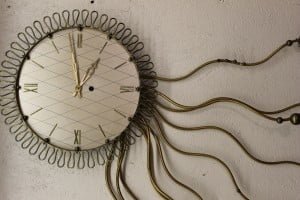
I have no idea as to who made this great whimsical windup clock. I do know that it works when I wind it up. However, the workings need a good cleaning for it to keep accurate time.
On the face just below the Roman numeral 6 it says “German”
On the brass back of the clock it says “made in Germany”
There are no other obvious markings anywhere that I can see.
The face of the clock measures approximately 12” across. The brass finished looping that goes around the face of the clock measures approximately 2” tall.
The brass finished Roman numerals are about 1.5” long. Note the nice crisscross pattern on the face of the clock. The tendrils that appear to come out of the back of the clock are attached to a steel ring. The clock sits in the steel ring. The ring and tendrils are attached to the wall by 2 screws. And the clock is mounted into the ring. For added security the clock itself can be mounted to the wall. The resin balls attached to the tendrils range from 1.0” to .75” to .25” The gold color of the tendrils does not look original. Not all of the tendrils lay flat but they weren’t meant to. The intent was to create relief or elevation. It feels like its lifting from the wall. The whole thing measures 3.5’ tall by 5’ long. I really like this piece. I have only seen one other in my many years of collecting. Now it needs a great place to be displayed.


Monday, November 17, 2014

MID CENTURY MODERN FLOOR LAMP WITH ACCOMPANYING TABLES

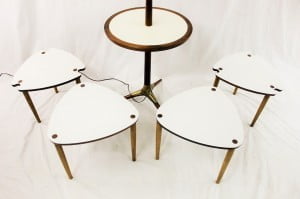
Rising a sleek 64” and topped with a 17” tall by 14” wide fabric shade, that’s in great condition, this tall warm walnut and brass finished floor lamp has a sophisticated appeal.  As you can see by the photos it is anchored with a built in white laminate tablIMG_2094 (2) - Copye top wrapped by walnut on the ends. This table is a useful 17.5” diameter and is 22” up from the three legged brass finished base.  The 4 stacking  white laminate side tables are included with this lamp making it a very rare and useful combination.  Where else can you purchase such a modern matching grouping? This just isn’t done anymore.  The designer and manufacturer were thinking outside of the box…ahead of the curve. This grouping is just as fresh and original today as it was 60 years ago probably more so.

GERALD THURSTON DESK LAMP FOR LIGHTOLIER

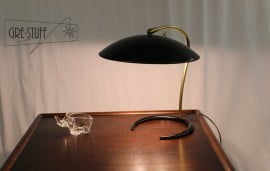
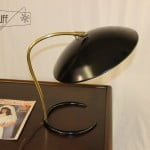
Looking like it arrived via a time machine from the late 1950’s this awesome desk lamp has been and still is shining brightly with nearly 60 years of cool.  With a newly painted shallow profile 15.5” across shade and a simple, sexy, thin brass 16” stem attached to a 9” horse shoe shaped black metal base it purrs perfection with its simplicity. Gerald Thurston, a respected and talented designer doing business with Lightolier; a quality conscious lighting company, equals quality in tandem. Cool never goes out of style when done by the likes of Gerald Thurston for Lightolier.

ADRIAN PEARSALL, CRAFT ASSOCIATES PLATFORM SOFA

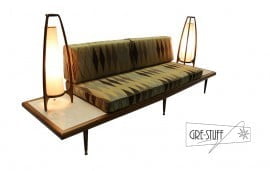
Newly refinished and professionally re-upholstered and always sought after, this 9.5 long day bed / platform sofa is quite an eye full. A new 4″ thick seat cushion insures a firm, comfortable seating arrangement for up to 4 people. The frame is solid walnut and wraps around laminate covered built in table tops. The sleek wood legs are finished with a walnut stain and the ends are finished with brass caps. Use your imagination, this classic piece designed by one the period’s best modernist will enhance any location that it is installed in.

The dimensions are as follows: 104″ long, 31″ deep, 30″ tall; 72″ seating area.

The tables measure 26” by 19”craft associates

Adrian Pearsall was trained as an architect but is best known for his furniture design. He founded Craft Associates in 1952 and achieved immediate success by providing affordable, stylish, quality furniture that incorporated the use of strong lines and unique color combinations. Pearsall is best known for his dramatic high-backed chairs, signature gondola sofas and sofas with attached end tables, of which have become highly valued among collectors.

Vorando Turnabout Table Fan

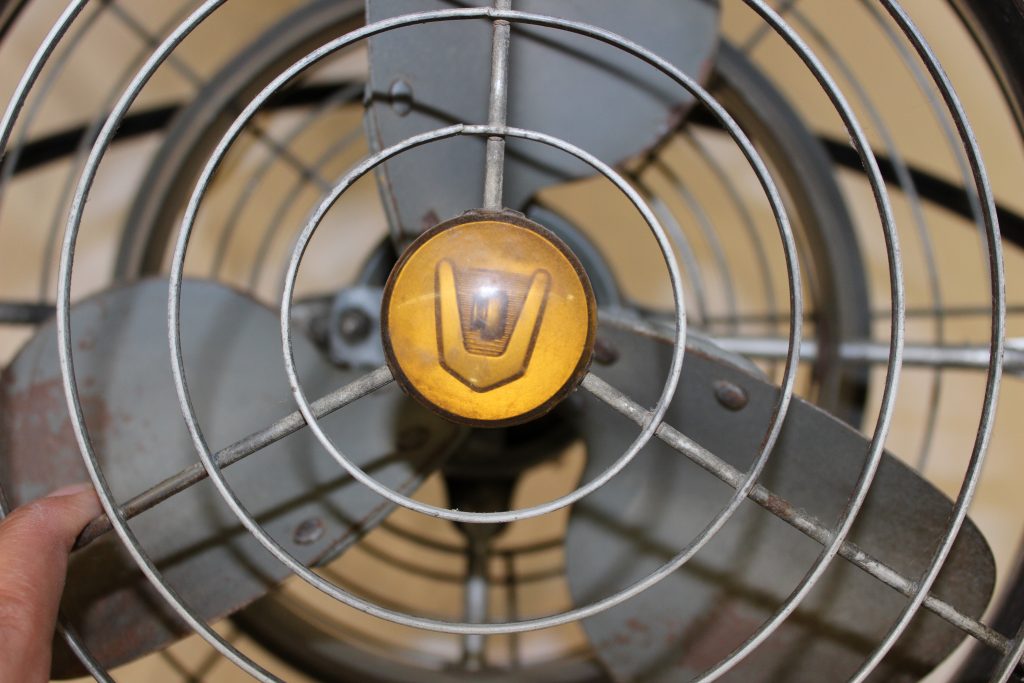
Today we take for granted the reliable comfort of air conditioning, the mechanics of it often invisible to us.  Adjust a knob or push a button and forget about it for months.  Air conditioning has been around since the early 1930’s but back then it was generally used in movie theaters and department stores not the home. That took a few decades more to become installed everywhere.  In the mean time most of us used table, floor and window fans.   As the times changed so did the styling of these metal rotating creatures. From the early part of the 20<sup>th</sup> century they were stodgy Victorian looking iron, copper and wire units. By the middle of the 20<sup>th</sup> century they became stream lined stylized steel beauties that reflected the confidence and ingenuity of the times.  One company in particular was the O.A. Sutton Corporation in Wichita Kansas.  They created the Vorando line of window, floor and table fans.  Through my years of collecting I have owned every model they produced from 1950 to 1960.  They are highly prized and are becoming scarce.   The model that really got my attention is the 1955-58c. Vornado Turnabout Table Fan.</p>
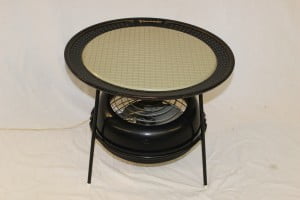
The space age “Jetson” style of the Vornado Turnabout Table Fan is exciting just to look at. The black steel base that supports the fan itself creates an open feel while the inlay of the fiberglass table top features a nice one piece tiled surface that makes for easy clean up with a damp cloth. This atomic age fan moves air like its rocket powered and all the while looking cool while doing so. The Vornado ducted design allows all of the air from the blade vortex to funnel out the front. When used in the upright position, the vortex is directed by a cone to push out around the edge of table.

Today the Vornado Turnabout table fan is still a functional piece of furniture as well as an art form from the mid 1950’s.

Some of the Features of the 1955-58c. Vornado Turnabout Table Fan includes:

There is a very interesting web-site the goes into greater detail about the engineering of the Vorando fan system it can be found at http:// www.vornadotrust.com/

Monday, August 4, 2014

New items

Hi Everyone!
We are very happy to say that even though we have been slow at posting here updates about our company here are a few of our newest items available for sale!
Thank you for checking them out at our website www.gre-stuff.com.


Friday, May 23, 2014

A Part of it All


Kofod Larsen was a Danish furniture designer and architect. His mid-century modern furniture designs were popular in his day. His pieces have become timeless and are still relevant and very fashionable today.
I can talk and write about mid century and Danish modern all day.  However, it’s still the hunt, the reclamation, and the return to life of these unique pieces that excite and generate the energy to talk and write about this subject matter. 
Recently, we removed the dull patina of time from a set of Danish Kofod Larsen chairs. As the grime was being lifted from the chairs, the original colors, light and life were returned. Restored to an all original finish these treasures brighten any space they are placed in. 

On a trip through Western Connecticut we rescued a large Danish secretary / desk from an old barn. The piece looked just as tired and weathered as the old building that it came out of. Some of the glue joints in the drawers were coming undone.  Veneer was peeling and an assortment of water rings and stains scarred the tired elegant piece. I swear I heard it sigh as I bent to lift it. The diamond in the rough sat quietly in the back of the van as we returned to Massachusetts.  And for a year it sat quietly in storage waiting its turn for reclamation. A year almost to the day that we rescued the piece we wheeled the patient to the work area where we assessed the damage done by time and weather. We jumped in and first stripped off the dried, flaking, chipped and split veneer. Then we took the drawers apart cleaned the old glue off the joints and off of the former veneered areas. The brass details were just that…details and they too were removed and cleaned. Next with love and care and assorted tools of the trade we removed the stains and water rings from the damaged finish.  Joints were refitted and glued new veneer attached. 
The piece sat for a day trussed up with clamps. And after the removal of the clamps, a rich oil base stain was lovingly applied by hand. Day after day the piece was slowly brought back to life. And day after day the work brought us joy. I believe that the joy was transferred back to the Danish piece as beauty and elegance renewed. Elegance rewarded.
Now this gem proudly stands against a wall and quietly and happily hums all day long.


Saturday, May 10, 2014

Pedestrian versus Unique

As defined by the Encarta English Dictionary the definition of unique is “different from others in a way that makes somebody or something special and worthy of note” While the definition of pedestrian, also by the Encarta English Dictionary, means “dull, ordinary, unimaginative or uninspired”


Original owners of American Modern and Danish Modern furniture from that narrow slice of time from the 1950’s through the early 1970’s, have been passing away while their pieces live on.  And here lies the rub. We are becoming over-saturated with the stuff. A mid century modern search on just two of the largest ecommerce sites EBay and Etsy will net you the following, with a search on EBay you will find over 75,000 assorted Mid Century Modern tables, chairs, sofas, dinnerware and lamps. A similar search on Etsy will net you 71,000 mid century modern pieces. Over-saturation like this causes a dulling of the period and of the common product.
 What was once unique and cool is getting close to becoming pedestrian.  The darker side of this dilemma will be a drop in value for what is now becoming the new mundane or…pedestrian pieces.  On the other hand, the bright side of this issue is that truly unique furniture design from the likes of Adrian Pearsall, Charles Ames his wife Ray, Harry Bertoia.  Arne Jacobsen, George Nelson, Paul McCobb, Eero Saarinen, Ib Kofod Larsen and Harvey Probber, just to name a few, will always remain unique, desirable and valuable. I for one will wait for the over-saturation to subside and pick up a few gems from the fray along the way. 

Thursday, April 24, 2014

Vorando Turnabout Table Fan

Today we take for granted the reliable comfort of air conditioning, the mechanics of it often invisible to us. 
 
Adjust a knob or push a button and forget about it for months.  Air conditioning has been around since the early 1930’s but back then it was generally used in movie theaters and department stores not the home. That took a few decades more to become installed everywhere.  In the mean time most of us used table, floor and window fans.   As the times changed so did the styling of these metal rotating creatures. From the early part of the 20th century they were stodgy Victorian looking iron, copper and wire units. By the middle of the 20th century they became stream lined stylized steel beauties that reflected the confidence and ingenuity of the times.  One company in particular was the O.A. Sutton Corporation in Wichita Kansas.  They created the Vorando line of window, floor and table fans.  Through my years of collecting I have owned every model they produced from 1950 to 1960.  They are highly prized and are becoming scarce.   The model that really got my attention is the 1955-58c. Vornado Turnabout Table Fan.


The space age “Jetson” style of the Vornado Turnabout Table Fan is exciting just to look at. The black steel base that supports the fan itself creates an open feel while the inlay of the fiberglass table top features a nice one piece tiled surface that makes for easy clean up with a damp cloth. This atomic age fan moves air like its rocket powered and all the while looking cool while doing so. The Vornado ducted design allows all of the air from the blade vortex to funnel out the front. When used in the upright position, the vortex is directed by a cone to push out around the edge of table.
Today the Vornado Turnabout table fan is still a functional piece of furniture as well as an art form from the mid 1950’s.
Some of the Features of the 1955-58c. Vornado Turnabout Table Fan includes:


  • Dimensions- Height 19.50" x Table Width 22"
  • Steel Construction
  • Twin Oil Ports for Easy Maintenance Every 3 Months.
  • Turnabout Feature Allows the Fan to Direct the Air Horizontally or Vertically
  • 3 Speed Operation

There is a very interesting web-site the goes into greater detail about the engineering of the Vorando fan system it can be found at http:// www.vornadotrust.com/

Saturday, April 19, 2014

The Heart Still Beats

Everything was just right.  Everything that was meant to mix or line up did so and did so right on time and then…the birth of cool in America bloomed into existence. Like an old winter coat we heaved off the stodgy way to live and wrapped our lives in a spring jacket of fresh ideas that was constructed from everything from art to architecture. From industry to the home everything was re-imagined and re-designed. America was experiencing a cultural enlightenment / revolution and nothing was spared.  In the 1960’s the art world gave us talented creators like Andy Warhol and Roy Lichtenstein. In the mid 1950’s Architects like Frank Lloyd Wright would give us the beautiful Guggenheim museum in NYC.  In 1962 Eero Saarinen gave us the Dulles International Airport in Northern VA. While 10 years earlier Mies van der Rohe delivered the McCormick House residence in Elm Hurst Illinois.  And of course those modern offices and homes sported great furniture designed by the likes of Paul McCobb, Herman Miller, Adrian Pearsall, and Florence Knoll
These artists and architects are only a few of the many who contributed to the enlightenment. Fashion, advertising, aviation, electronics and automobiles all benefited from the movement as well.

Unfortunately, for whatever reason the bloom on this flower of enlightenment began to fade as time marched toward the early 1970’s.  Was it Nixon taking us off the gold standard? Was it imports from Hong Kong and China? Maybe it was the Vietnam War or the breakup of the Beatles!  None the less, the heartbeat of the movement flat lined for the next 30 years. The art and architecture of the period lay dormant.  Some of it became invisible and quite a bit of it was turn down and or thrown out.  So as the movement lay idle for the next 30 years we suffered Watergate, Disco, Abscam, gas lines, high interest rates, recessions and the early days of terrorism.

Ironically the dread and bad habits of the past 30 years were instrumental in the resurrection of some of the elements, some of the dynamics of the beautiful movement.  Unfortunately the majority of the creators of this enlightenment have since passed away and as a result we only have a limited live inventory from that moment in time. I want to believe, I do believe that the success of the resurgence is due to the honesty and purity of the designs and the high prices these treasures fetch today back up my belief.
 

The heart of it all still beats.