Thursday, January 8, 2015

SURVIVING THE MID CENTURY MODERN LOG JAM

I have been on the hunt for select items that are not so common in the way of mid century or Danish modern.  In the recent past I was worried that the MCM period would become an internet log jam by way of its own clutter.  And a quarter of a million mediocre chairs, chests, lamps, sofas, dining sets, end tables and all of their accessories say it’s so. They tend to jam up on the better known e-commerce sights.  Where they sit idle quite often incorrectly priced, poorly described and mislabeled. Metaphorically speaking, as these pieces are crushed under their own weight and settle to the bottom of the log jam, their prices drop along with them. The clutter and falling prices have created over saturation, disinterest and lower values.
In order to rise above the clutter one has to collect rarer and more unique pieces. This involves turning your back to the log jam and creating a buffer or a margin from the clutter, reaching deeper into ones own pockets, traveling further for pieces and doing better research. I have been practicing what I preach and it works. And for awhile now my inventory has been improving. I have managed to lay my hands on pieces designed by Paul Laszlo, Milo Baughman, Harvey Prober, Gerald Thurston and Leon Rosen just to name a few. Like mining for gold I have struck several new veins of limited, not so available, exciting, cool pieces.
Avoiding the log jam I have been returning them slowly back into the mainstream.

A MODERN DAY AT KING TUT’S TOMB

This past summer I arrived early for a sale of vintage goods from a property owner in Pawtucket Rhode Island. I was pleasantly surprised by the “beauty in the rough” of this lively urban community situated just north of thriving Providence RI.
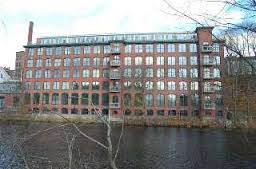
With plenty of time and curiosity I parked my ride and went strolling through the city of Pawtucket.  The first impression was one of former greatness. Large homes, grand apartment buildings beautifully designed factories and textile mills all in different degrees of decline and reclamation. I remember when Lower Manhattan and Brooklyn looked like this. You could feel it; Pawtucket was on the upswing. It has developed a Bohemian edge. Rents are still affordable property prices are still obtainable by regular people standards. The local residents of multiple cultures are amiable.  As a matter of fact after doing some research I learned that Pawtucket is becoming known as a center for arts and culture. In 2008 a documentary titled Pawtucket Rising also chronicled the influx of artists and cultural activities into previously blighted areas of the city.
My meandering takes me to my destination where I encounter a handsome 21,000 sqft Mission/Spanish Revival building designed by architect John F. O’Malley and constructed in 1926. It is three stories in height, with its facade faced in buff brick, laid in Flemish bond, and trimmed in cast stone. The building’s first floor was devoted to commercial tenants, with the upper floors devoted to a private members only club and their functions.
I enter the large foyer and I’m directed down a set of wide marble steps that empty into what was once a large, paneled, tiled and windowless bar room and dining room.
As I wait for my eyes to adjust from summer sunshine to basement bar room dark I notice odd shapes of things lined up along walls and stacked on shelves. In the dark, what first appears as narrow hallways are actually narrow paths that separate stacks of vintage furniture and accessories.
I immediately start to recognize the styling’s of George Nelson’s metal cubist tables, A Paul Laszlo credenza, Paul McCobb Headboard, Milo Baughman chrome and glass shelving a bench by Harvey Probber. Tables by Robs john Gibbings and Widdicomb.  Along with Gerald Thurston, Lightolier and Kovacs, Russell Wright was also represented by some of his floor lamps. I hit the mother load a treasure trove. Tuts Tomb.  As you might imagine I was like a kid in a candy store.  It took two entire days to collect what I wanted and load it into my truck.  I can honestly say that it was one of the best couple of days in my mid century modern life.

Sunday, November 30, 2014

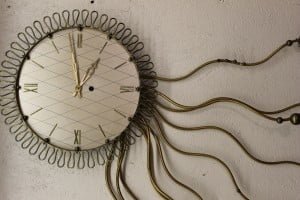
MID CENTURY MODERN WHIMSICAL WINDUP CLOCK

I have no idea as to who made this great whimsical windup clock. I do know that it works when I wind it up. However, the workings need a good cleaning for it to keep accurate time.
On the face just below the Roman numeral 6 it says “German”
On the brass back of the clock it says “made in Germany”
There are no other obvious markings anywhere that I can see.
The face of the clock measures approximately 12” across. The brass finished looping that goes around the face of the clock measures approximately 2” tall.
The brass finished Roman numerals are about 1.5” long. Note the nice crisscross pattern on the face of the clock. The tendrils that appear to come out of the back of the clock are attached to a steel ring. The clock sits in the steel ring. The ring and tendrils are attached to the wall by 2 screws. And the clock is mounted into the ring. For added security the clock itself can be mounted to the wall. The resin balls attached to the tendrils range from 1.0” to .75” to .25” The gold color of the tendrils does not look original. Not all of the tendrils lay flat but they weren’t meant to. The intent was to create relief or elevation. It feels like its lifting from the wall. The whole thing measures 3.5’ tall by 5’ long. I really like this piece. I have only seen one other in my many years of collecting. Now it needs a great place to be displayed.


Monday, November 17, 2014

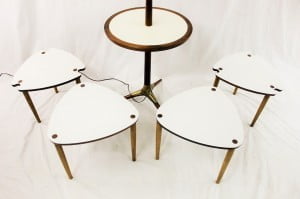
MID CENTURY MODERN FLOOR LAMP WITH ACCOMPANYING TABLES

Rising a sleek 64” and topped with a 17” tall by 14” wide fabric shade, that’s in great condition, this tall warm walnut and brass finished floor lamp has a sophisticated appeal.  As you can see by the photos it is anchored with a built in white laminate tablIMG_2094 (2) - Copye top wrapped by walnut on the ends. This table is a useful 17.5” diameter and is 22” up from the three legged brass finished base.  The 4 stacking  white laminate side tables are included with this lamp making it a very rare and useful combination.  Where else can you purchase such a modern matching grouping? This just isn’t done anymore.  The designer and manufacturer were thinking outside of the box…ahead of the curve. This grouping is just as fresh and original today as it was 60 years ago probably more so.

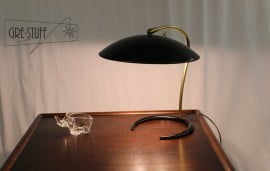
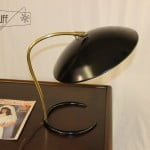
GERALD THURSTON DESK LAMP FOR LIGHTOLIER

Looking like it arrived via a time machine from the late 1950’s this awesome desk lamp has been and still is shining brightly with nearly 60 years of cool.  With a newly painted shallow profile 15.5” across shade and a simple, sexy, thin brass 16” stem attached to a 9” horse shoe shaped black metal base it purrs perfection with its simplicity. Gerald Thurston, a respected and talented designer doing business with Lightolier; a quality conscious lighting company, equals quality in tandem. Cool never goes out of style when done by the likes of Gerald Thurston for Lightolier.

ADRIAN PEARSALL, CRAFT ASSOCIATES PLATFORM SOFA

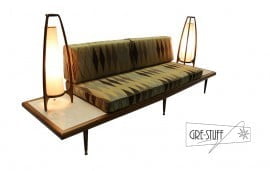
Newly refinished and professionally re-upholstered and always sought after, this 9.5 long day bed / platform sofa is quite an eye full. A new 4″ thick seat cushion insures a firm, comfortable seating arrangement for up to 4 people. The frame is solid walnut and wraps around laminate covered built in table tops. The sleek wood legs are finished with a walnut stain and the ends are finished with brass caps. Use your imagination, this classic piece designed by one the period’s best modernist will enhance any location that it is installed in.

The dimensions are as follows: 104″ long, 31″ deep, 30″ tall; 72″ seating area.

The tables measure 26” by 19”craft associates

Adrian Pearsall was trained as an architect but is best known for his furniture design. He founded Craft Associates in 1952 and achieved immediate success by providing affordable, stylish, quality furniture that incorporated the use of strong lines and unique color combinations. Pearsall is best known for his dramatic high-backed chairs, signature gondola sofas and sofas with attached end tables, of which have become highly valued among collectors.

Vorando Turnabout Table Fan

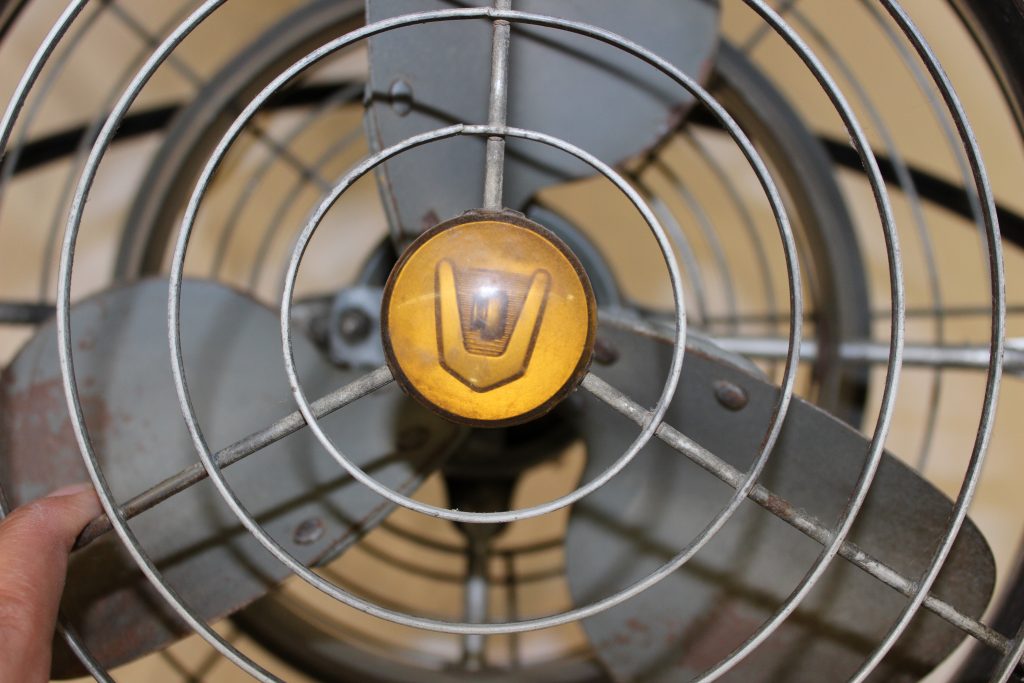
Today we take for granted the reliable comfort of air conditioning, the mechanics of it often invisible to us.  Adjust a knob or push a button and forget about it for months.  Air conditioning has been around since the early 1930’s but back then it was generally used in movie theaters and department stores not the home. That took a few decades more to become installed everywhere.  In the mean time most of us used table, floor and window fans.   As the times changed so did the styling of these metal rotating creatures. From the early part of the 20<sup>th</sup> century they were stodgy Victorian looking iron, copper and wire units. By the middle of the 20<sup>th</sup> century they became stream lined stylized steel beauties that reflected the confidence and ingenuity of the times.  One company in particular was the O.A. Sutton Corporation in Wichita Kansas.  They created the Vorando line of window, floor and table fans.  Through my years of collecting I have owned every model they produced from 1950 to 1960.  They are highly prized and are becoming scarce.   The model that really got my attention is the 1955-58c. Vornado Turnabout Table Fan.</p>
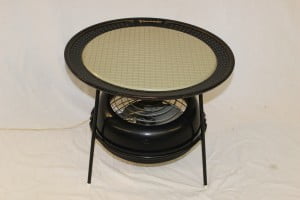
The space age “Jetson” style of the Vornado Turnabout Table Fan is exciting just to look at. The black steel base that supports the fan itself creates an open feel while the inlay of the fiberglass table top features a nice one piece tiled surface that makes for easy clean up with a damp cloth. This atomic age fan moves air like its rocket powered and all the while looking cool while doing so. The Vornado ducted design allows all of the air from the blade vortex to funnel out the front. When used in the upright position, the vortex is directed by a cone to push out around the edge of table.

Today the Vornado Turnabout table fan is still a functional piece of furniture as well as an art form from the mid 1950’s.

Some of the Features of the 1955-58c. Vornado Turnabout Table Fan includes:

There is a very interesting web-site the goes into greater detail about the engineering of the Vorando fan system it can be found at http:// www.vornadotrust.com/